- 0243394034
- info@centralcoastseo.com.au
- Google 1st Pages Guaranteed in Writing.


Tracking the User Journey in GA4 Changes Everything for Small Businesses
Tracking the User Journey in GA4 Changes Everything for Small Businesses
Running Central Coast SEO, one of the most common frustrations I hear from small business owners is this: “We’re getting traffic, but we don’t know if it’s actually working.” That disconnect is exactly where Google Analytics 4 becomes powerful.
The reality is that SEO is no longer about clicks alone. It is about what happens after the click. GA4 is built on an event-based model, meaning every action a user takes on your site can be tracked and understood, from page views to conversions . This allows you to move beyond surface-level metrics and start seeing the real story of how users interact with your business.
For small businesses, this is critical. If you are investing time or money into SEO, you need to understand not just where users come from, but how they move, where they drop off and what ultimately drives results.
Moving Beyond Traffic to Real SEO Value
In my experience, many businesses still measure SEO success based on rankings or traffic volume. While those metrics have their place, they rarely tell the full story.
Tracking the user journey allows you to connect SEO efforts directly to business outcomes such as enquiries, bookings or purchases. By mapping how users move through your website, you can identify which pages drive engagement and which ones lose potential customers.
For example, a blog post may attract a large volume of traffic, but if users leave immediately, it is not contributing to your bottom line. On the other hand, a service page with fewer visits may generate a higher proportion of conversions. Without tracking the journey, these insights remain hidden.
For small business owners, this means shifting focus from quantity to quality. It is not about how many visitors you attract, but how effectively you guide them towards taking action.
How GA4 Reveals the Full Customer Journey
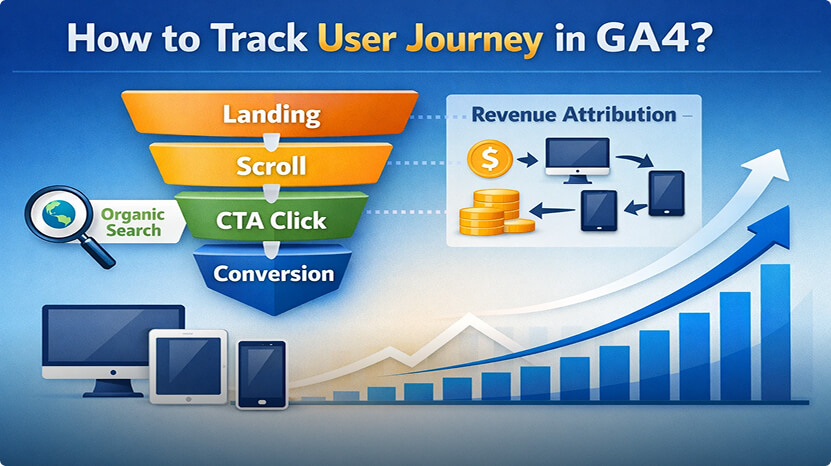
One of the most valuable features in GA4 is the ability to visualise user journeys through tools such as path exploration and funnel analysis. These allow you to see exactly how users move from one page to another, where they enter your site and where they exit.
Funnel exploration, in particular, helps you define key steps in your conversion process and identify where users drop off. This is incredibly useful for small businesses because it highlights friction points that may be costing you leads or sales.
For instance, you might discover that users frequently abandon your site on a contact page, suggesting issues with form design or clarity. Alternatively, you may find that users who visit certain pages are far more likely to convert, indicating opportunities to drive more traffic to those areas.
These insights allow you to make informed decisions rather than relying on guesswork.
Turning Insights into Action
Data on its own does not create results. The real value comes from how you use it.
when I analyse user journeys for clients, I focus on identifying actionable opportunities. If users are dropping off early, we refine content to better match intent. If they are not progressing to key pages, we improve internal linking and calls to action. If conversions are low, we optimise landing pages to remove friction and build trust.
This process creates a continuous improvement loop. You track behaviour, identify issues, implement changes and then measure the impact. Over time, this leads to stronger engagement, higher conversion rates and more effective SEO performance.
For small businesses, this approach is far more sustainable than chasing rankings alone. It ensures that every improvement contributes directly to business growth.
Connecting SEO to Revenue
One of the biggest advantages of tracking user journeys in GA4 is the ability to connect SEO activity to real revenue.
By setting up key events such as form submissions, purchases or calls, you can see which traffic sources and pages are driving actual results. This allows you to prioritise efforts that deliver value and reduce investment in areas that do not.
For example, you may discover that certain keywords or landing pages consistently lead to high-value conversions. This insight can guide your content strategy, helping you focus on topics and services that generate the greatest return.
For small business owners, this level of clarity is invaluable. It transforms SEO from a vague marketing activity into a measurable growth channel.
Why Most Small Businesses Get This Wrong
The biggest mistake I see is treating GA4 as a reporting tool rather than a decision-making tool. Many businesses set it up, glance at a few metrics and then ignore it.
The reality is that GA4 requires a structured approach. You need to define what success looks like, configure events properly and regularly review user behaviour. Without this, you are missing out on the insights that could drive meaningful improvements.
Another common issue is failing to connect pre-click and post-click data. Integrating search data with GA4 allows you to see not just how users find you, but how they behave once they arrive. This creates a complete picture of your SEO performance.
How I Help Small Businesses Use GA4 Effectively
At Central Coast SEO, I focus on simplifying GA4 for small business owners. I help set up tracking that aligns with real business goals, ensuring that every key action is measured and understood.
From there, I analyse user journeys to identify opportunities for improvement and work with clients to implement changes that drive results. The aim is not just to collect data, but to use it in a way that supports growth.
By making SEO performance visible and measurable, GA4 becomes a powerful tool for decision-making rather than just a dashboard of numbers.
Why Now Is the Time to Take Action
In today’s digital landscape, visibility alone is not enough. You need to understand how users interact with your business and how to guide them towards conversion.
Tracking the user journey in GA4 gives you that insight. It allows you to see what is working, what is not and where to focus your efforts. For small businesses, this can be the difference between wasted traffic and meaningful growth.
If you want help setting up GA4 properly and turning your SEO data into real results, contact Central Coast SEO today and let’s make your marketing measurable.